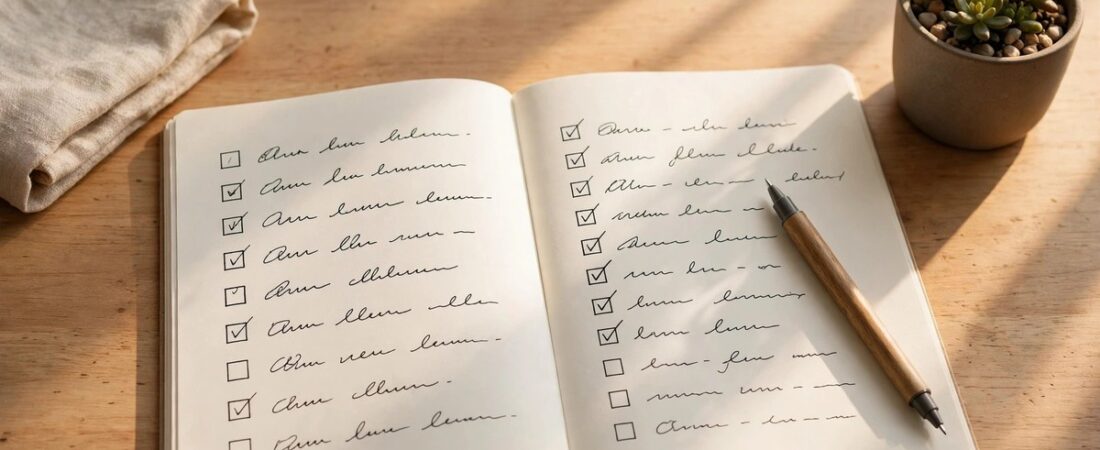
When people picture an online business, they imagine dashboards, project boards, and a dozen apps all talking to each other. My reality is much simpler. I run my business with a plain notebook, a pen, and a system I built for myself over time. It works because it is easy, and easy is what keeps me consistent.
1. One page for today’s three tasks
Every morning, I open a fresh page and write down exactly three tasks. Not ten. Three. I pick the three things that would make the day feel like a win if I finished them, like writing one reel script or answering customer emails.
If I finish all three early, I can add one more. On busy days, three is plenty. This one habit keeps me from feeling overwhelmed before the day even starts.

2. An ideas page for everything that pops into my head
New ideas come at the worst times. In the kitchen, in the car, right before sleep. I used to lose them all. Now I keep a running “Ideas” page near the back of the notebook, and anything that shows up goes there in a few words.
Nothing needs to be perfect on this page. It is just a safe place to catch ideas before they disappear. Once a week, I look through it and move the good ones into my plans.
3. A simple content calendar on one page
I plan my content one week at a time on a single page. Monday through Sunday, with one line per day. On each line, I write what I plan to post or work on, like “reel script” or “blog draft” or “rest day.”
Seeing the whole week in one glance helps me stay balanced. If I notice three heavy days in a row, I move things around. Planning this way takes me ten minutes every Sunday night.
4. A monthly expense tracker
Money coming in and money going out gets its own page each month. I write two columns: what I earned and what I spent. Domain renewals, app subscriptions, ad spend, anything business-related goes in.
I started doing this when I realized I had no idea where my money was going. Now I check it weekly, and it keeps me honest. You do not need accounting software to know your numbers. You need one page and five honest minutes.
5. A weekly review every Sunday
Sunday night is my review time. I look back at the week and ask myself three questions: What did I finish? What did I skip, and why? What is the one thing I want to do better next week?
I write the answers in a few short lines. Some weeks the answers are great. Some weeks I barely got anything done, and that is okay. The point is to notice. I drove trucks for long hours for years, and I learned there that small steady effort beats big bursts that burn you out.
6. A done list, not just a to-do list
My notebook also has a “Done” section, and this one matters more than people think. Every time I finish something, I write it there. Replied to three customer emails. Posted the reel. Scheduled the blog post.
On days when I feel like I did nothing, I flip to this page and see the truth. It reminds me that small steps add up. Learning in small steps is how I got here, with no tech background and no marketing experience. The done list is my proof.
7. Project pages for bigger goals
When I am working on something big, like launching a product or planning a month of content, it gets its own page. I write the goal at the top, then break it into small steps I can check off one by one.
This keeps big projects from feeling scary. A product launch is just twenty small tasks written down. I do them one at a time, and one day it is done.

8. A contacts and passwords note (the safe kind)
I keep a page for important contacts and account notes, like which email I used for which service. I never write full passwords in the notebook. I write hints that only I understand, like “the usual plus the dog’s name,” because notebooks can get lost.
It sounds old-fashioned, but it has saved me more than once when I needed to log in somewhere and could not remember which account I used.
Conclusion
You do not need a fancy system to run an online business. You need a way to remember what matters, and a notebook does that job well. Start with one page of three tasks tomorrow morning. That is the whole beginning, and it is enough.